

Back to blog
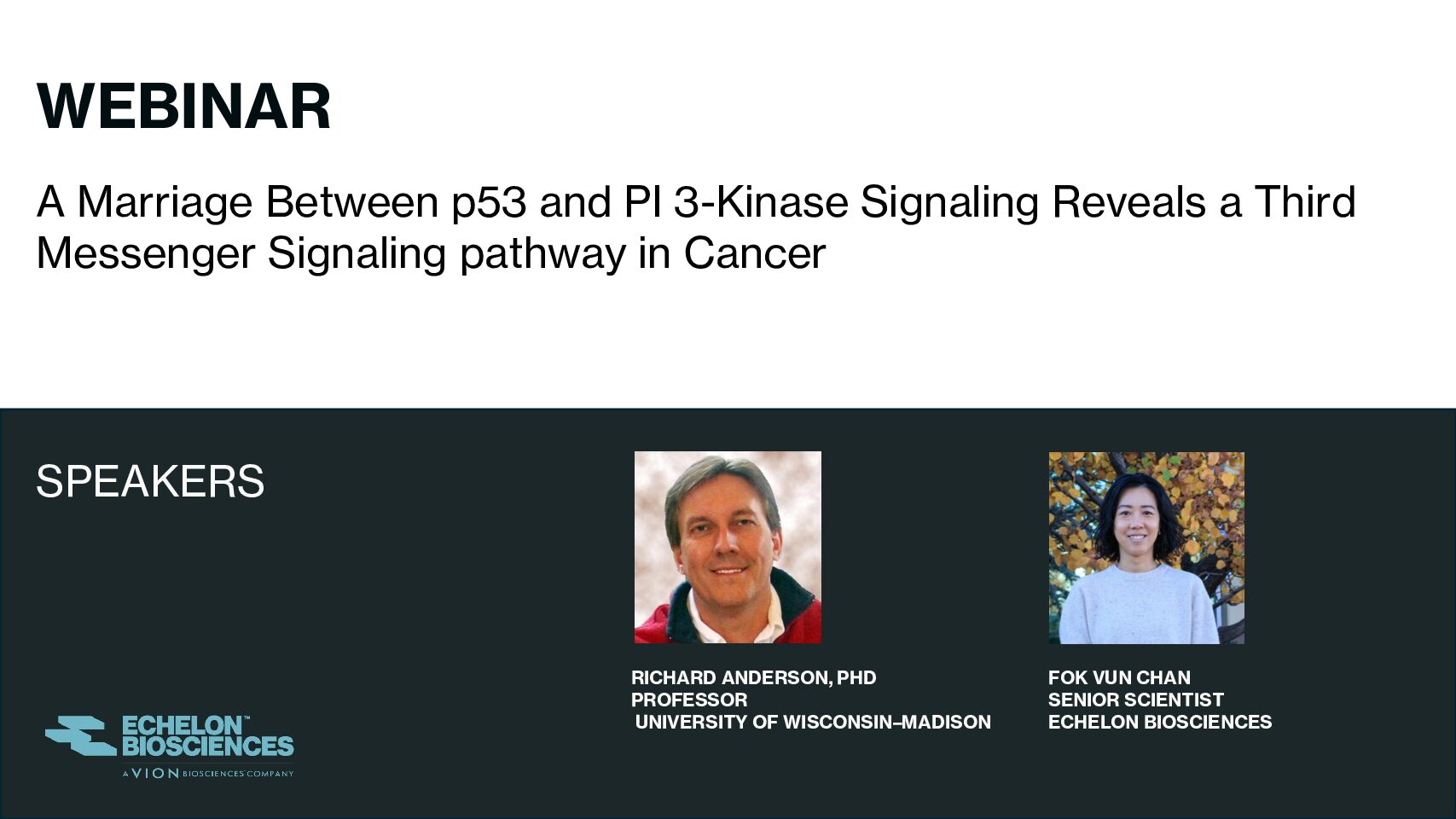
A Marriage Between p53 and PI 3-Kinase Signaling Reveals a Third Messenger Signaling pathway in Cancer
Webinar with Dr. Richard Anderson | December 10, 2025
Phosphoinositide lipids (PIPs) are second messengers that modulate most biological processes and have fundamental roles in multiple human diseases. These PIPs are phosphorylated on the inositol head group generating seven distinct PIP second messengers that are spatially organized to regulate membrane trafficking, cell migration and invasion, cell stress pathways, cell proliferation and cell death. In the canonical PIP pathways, the PIPs are organized as lipids immersed in membrane compartments with the PIP myo-inositol head at the cytoplasmic interface.
Remarkably the PIPs also become covalently linked at a repertoire of regulatory proteins in cells. These PIP linked proteins are both nuclear and cytoplasmic. The founding member is p53. Now we know that p53 becomes initially linked to a PI likely through the glycerol backbone. The p53-PI is then acted on by PIP kinases and phosphatases ultimately generating a p53-phosphoinositol-3,4,5-trisphosphate (p53-PIP3) signalosome that activates a nuclear Akt pathway that appears key for p53’s roles in cancer. We have named this PIP linked pathway a third messenger pathway. This new pathway involves many regulatory proteins that will require novel approaches to detect the PIP linkage on proteins, and their clear diagnostic and therapeutic possibilities were discussed.
Check here for future events!
Echelon has everything you need to explore PIP signaling! Explore our full line of Lipids.
Custom synthesis services available. Click to get started.
0.2
/ 0.3
Related Articles
Stay informed with our informative blog posts.
From Matrix to Microthrombi: Hyaluronan-Platelet Interactions in Inflammatory Disease
Webinar with Dr. Aaron Petrey | March 18, 2026 In this presentation, Dr. Petrey explored how the extracellular matrix component hy
Uncovering New Signaling Pathways in Cancer
A Marriage Between p53 and PI 3-Kinase Signaling Reveals a Third Messenger Signaling pathway in Cancer Webinar with Dr. Richard An
Discover SENT-Seq & its Impact on LNPs
Using single cell RNA sequencing to identify novel lipid nanoparticle candidates with Dr. Kalina Paunovska, co-founder of Nava The
Decoding Lipid-Immune Interactions/ Insights from Dr. Ganesh Halade’s Webinar
This webinar focused on the fundamental role of bioactive lipids in resolving inflammation and preventing chronic inflammation. Th
0.3
/ 0.3
Get in Touch
If you have any questions or would like to learn more about our services, feel free to reach out to us. We’re here to help!
Biosciences